
Cottonwood Heights Unclaimed Money
Cottonwood Heights only became a city in 2005, but many of its residents have lived in the area for decades, often under different addresses and with financial accounts tied to old Salt Lake County records. Unclaimed money from those dormant accounts, utility refunds, and forgotten wages sits with the Utah State Treasurer until someone files a claim. The search is free at mycash.utah.gov, requires no account or login, and there is no deadline to file. If your name is on file, the property is still yours to collect.
Cottonwood Heights Quick Facts
How to Search for Cottonwood Heights Unclaimed Money
The Utah State Treasurer's Unclaimed Property Division maintains mycash.utah.gov, the official place to search for unclaimed property in Cottonwood Heights and every other city in Utah. The process takes only a few minutes. Go to the site, enter your last name, and review the results. No account is needed. You will see the type of property, the company that originally held it, and a general value range. If a listing looks like yours, you can start your claim right from the search results page.
Because Cottonwood Heights was incorporated in 2005, many long-time residents have financial histories that stretch back well before the city had its current boundaries. Bank accounts opened at branches in unincorporated Salt Lake County, utility accounts from before the city formed, and wage payments from employers who recorded an old county address can all show up in the state database under your name. The key is to search using any name you have used, including maiden names, former legal names, or business names if you are a small business owner.
The Utah State Treasurer's MyCash portal shown below is the primary search tool for Cottonwood Heights unclaimed money.
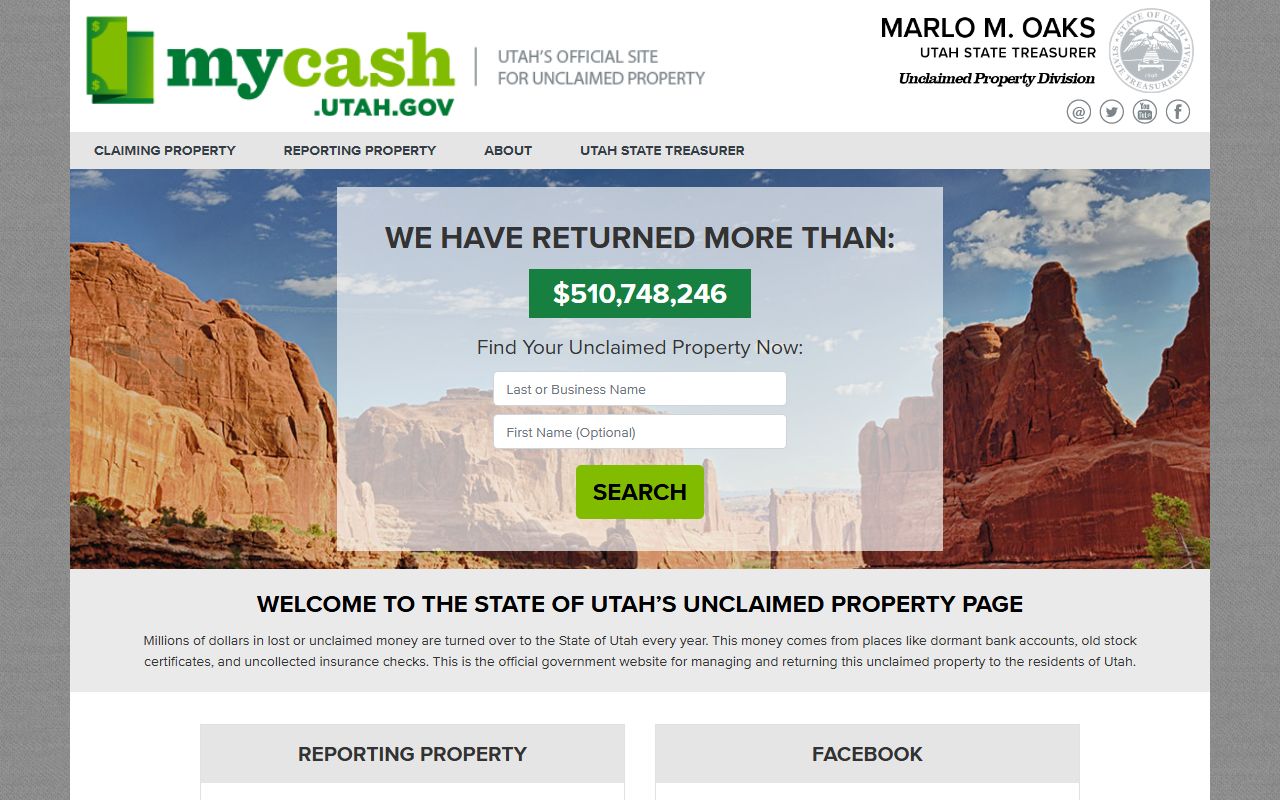
The MyCash portal is the official state search tool and covers all property reported on behalf of Cottonwood Heights residents.
The portal also lets businesses search by company name. If you own or manage a business in Cottonwood Heights, a vendor payment or uncashed refund check may be sitting in the state system under your business name. Search the company name the same way you would search a personal name. Business claims sometimes require additional documentation, but the search itself is open to anyone at no cost.
Types of Unclaimed Property Cottonwood Heights Residents Lose Track Of
Cottonwood Heights residents have a somewhat unique profile when it comes to unclaimed property. Many families have lived near the Cottonwood Canyons area for a long time, some for generations. That means old accounts from banks that have since merged or changed names, insurance policies taken out years ago, and stock dividends tied to companies that were bought or restructured are all common finds in the state database. Older accounts tend to generate bigger refunds because they sat unclaimed longer while the balance was preserved.
There are also residents who moved to Cottonwood Heights more recently from other parts of the Salt Lake Valley or from other states. Former renters who put up security deposits in Murray, Midvale, or South Salt Lake and then moved to Cottonwood Heights without collecting their refund are a good example. Utility deposits follow the same pattern. You put down a deposit when you started service, moved out, and the utility company sent a refund check to an address that was no longer current. That check bounced back and eventually got reported to the state.
Common types of unclaimed property for Cottonwood Heights residents:
- Dormant savings or checking accounts
- Uncashed payroll and vendor checks
- Utility refunds from former service addresses
- Insurance policy proceeds and premium refunds
- Stock dividends and investment account distributions
- Security deposits from prior rental units
- Gift card balances over state dormancy thresholds
Utah law sets specific dormancy periods before property gets reported. Wages and utility refunds hit the state after one year. Bank accounts take three years. Money orders require seven years, and traveler's checks take fifteen. Once those periods pass and the original holder can't reach the owner, the funds go to the state. The state keeps them indefinitely until the owner or their heirs file a claim.
Cottonwood Heights City Hall and County Resources
Cottonwood Heights City Hall is at 2277 E Bengal Boulevard, Cottonwood Heights, UT 84121. The Cottonwood Heights official city website covers local permits, services, and community programs. For unclaimed financial property, though, the city itself is not involved in the search or claim process. That runs entirely through the state, not local government.
Cottonwood Heights is part of Salt Lake County. All businesses and institutions in the city report unclaimed property to the Utah State Treasurer through the same statewide system used across Salt Lake County. The Salt Lake County unclaimed money page has more detail on county-wide resources and offices. Salt Lake County's offices in Salt Lake City handle a wide range of services, and county staff can sometimes help point residents toward state agencies if you have questions about a specific account or claim.
The screenshot below from the Utah Attorney General's office shows how Utah enforces compliance with unclaimed property reporting laws across the state, including Salt Lake County.
The Utah Attorney General's office works alongside the Treasurer to make sure businesses in Cottonwood Heights and across the state follow unclaimed property reporting rules.
MissingMoney.com as a National Search Tool
Running a search at MissingMoney.com is a good follow-up after checking mycash.utah.gov. This national database is endorsed by the National Association of Unclaimed Property Administrators (NAUPA) and pulls records from more than 39 states. If you lived in Colorado, Idaho, California, or anywhere else before settling in Cottonwood Heights, property from those states may be waiting in a different state's system. MissingMoney.com can surface those records in a single search.
The screenshot below shows the MissingMoney.com search interface, which Cottonwood Heights residents can use to check for property held in other states.
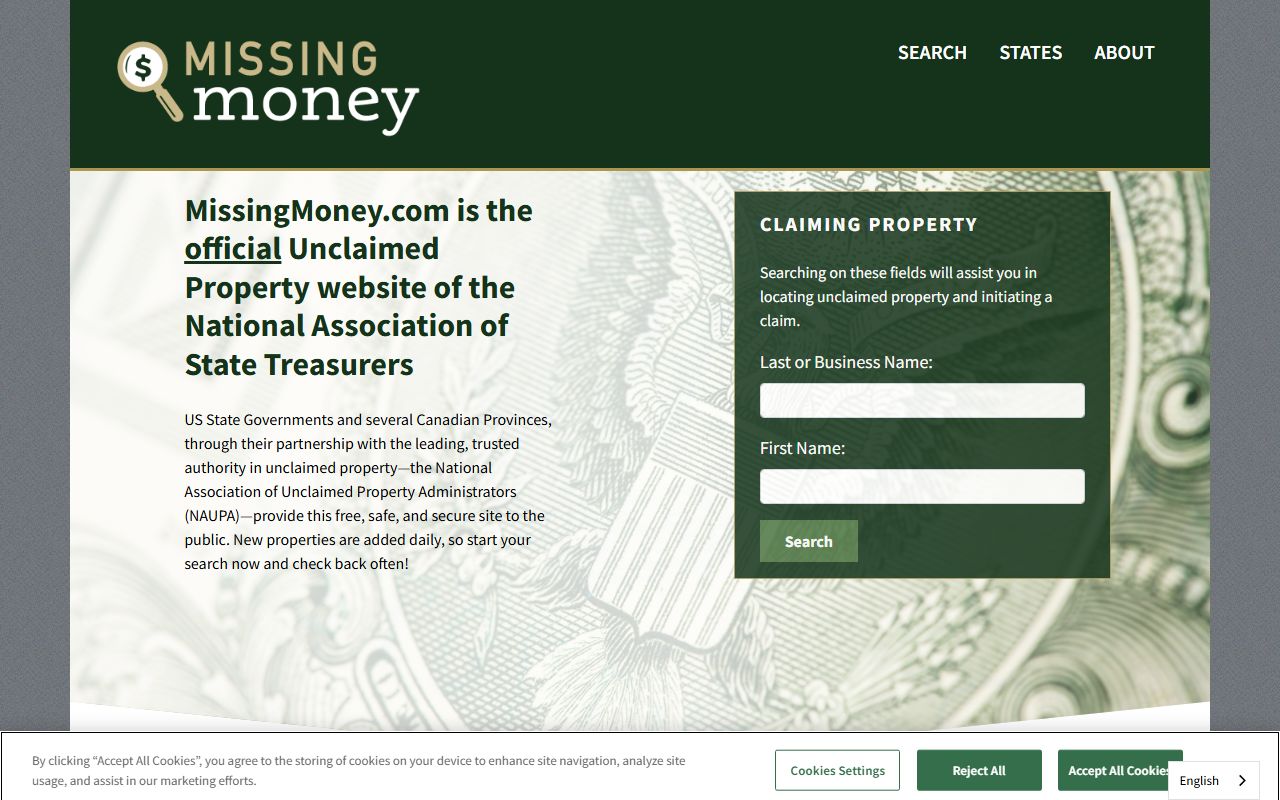
MissingMoney.com is free to search and covers records from dozens of state databases in a single place.
NAUPA's Utah information page at unclaimed.org/reporting/utah/ is another useful resource. It explains how Utah fits into the national unclaimed property system and provides links to other states' programs if you need to search elsewhere. Between mycash.utah.gov and MissingMoney.com, most residents can cover their full financial history in under ten minutes. Both searches are free.
Claiming Cottonwood Heights Unclaimed Funds
When you find a match at mycash.utah.gov, clicking the claim link opens the official claim form. You enter your contact details and answer a few questions to show you are the rightful owner. For most personal claims, a government-issued photo ID such as a Utah driver's license, state ID, or passport is sufficient. The state also typically asks for your Social Security number to match the record. Larger claims or more complex situations may require bank statements, old account records, or other supporting documents to verify ownership.
Claims for deceased owners follow a slightly different path. If you are collecting money that belonged to a parent or spouse who has died, you will need documents showing your legal right to that property. A death certificate is almost always required. Depending on the value and circumstances, you may also need a will, letters testamentary from a probate court, or an affidavit of heirship. The online claim form will walk you through what is needed based on the type of claim you select.
All claims are processed by the Utah State Treasurer's Unclaimed Property Division. Their phone number is (801) 715-3300. You can mail documents to P.O. Box 140530, Salt Lake City, UT 84114-0530. The physical office is at 168 N 1950 W Suite 102, Salt Lake City, UT 84116. Most approved claims are paid within a few weeks. There is no fee. You do not need a third party or recovery service. The full amount belongs to you.
Utah Unclaimed Property Law
Utah's unclaimed property program runs under Title 67, Chapter 4a of the Utah Code, which adopted the Revised Uniform Unclaimed Property Act. The law sets dormancy periods, reporting deadlines for holders, and the rights of property owners. One of the most important provisions is the no-deadline rule. Under Utah Code 67-4a-501, there is no time limit for an owner to reclaim property after it has been turned over to the state. It does not matter if the account went dormant ten years ago or last year. The right to claim does not expire.
Businesses and institutions in Cottonwood Heights are required to file unclaimed property reports with the state each year. The annual reporting deadline is November 1. Holders that fail to report face penalties under state law. The Utah Attorney General's office works with the Treasurer to audit holders and ensure compliance. That enforcement process is part of what keeps the state database accurate and current.
Utah's program has been running since 1957 in various forms and since 1984 under the current statutory framework. As of 2022, the state held $77.2 million in unclaimed funds. That year alone, $30.6 million was returned to owners. Since 1984, more than $131 million has gone back to rightful owners. About one in five Utah residents is estimated to have unclaimed property in the system. A quick search is worth the few minutes it takes.
Nearby Cities
These nearby Utah cities also have dedicated unclaimed money pages with local information and resources.