
Search Utah Unclaimed Money
Utah residents can search for unclaimed money through the Utah State Treasurer's Unclaimed Property Division at mycash.utah.gov. The state holds funds from dormant bank accounts, unpaid insurance proceeds, uncashed checks, wages, and safe deposit box contents until the rightful owner or heir files a claim. One in five Utahns has unclaimed funds waiting. Search is free, available at any time, and there is no deadline to claim what belongs to you in Utah.
Utah Unclaimed Money Quick Facts
How to Find Utah Unclaimed Money
The official search portal for Utah unclaimed money is mycash.utah.gov, run by the Utah State Treasurer's Unclaimed Property Division. The search is free and open around the clock. Type your name into the search box. The system checks all properties reported to the state from every county. You can also search by business name if you own or once owned a company that may have unclaimed funds tied to it.
The division is run by State Treasurer Marlo Oaks and Administrator Dennis Johnston. The physical office sits at 168 N 1950 W Suite 102, Salt Lake City, UT 84116. For questions, call (801) 715-3300. The reporting line for holders is 801-988-9466. You can mail a claim to: Unclaimed Property Division, P.O. Box 140530, Salt Lake City, UT 84114-0530. Online submission is the fastest option. The site lets you track your claim status after you file.
State Treasurer Oaks himself found unclaimed money after taking office, an overpaid medical bill he had no idea about. His experience is not unusual. Dormant accounts and forgotten checks add up quietly over time. Most people who find unclaimed money say they had no idea anything was waiting for them.
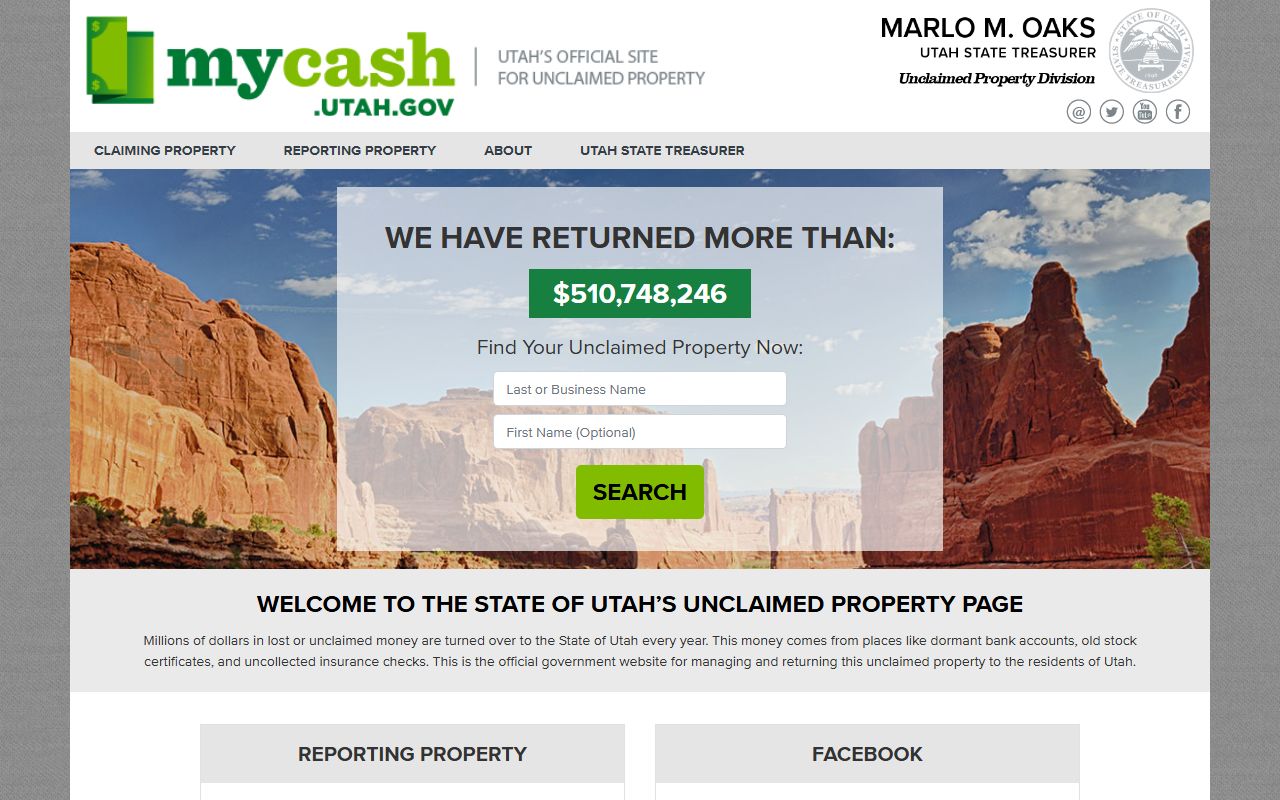
The state database at mycash.utah.gov is updated each year after businesses and institutions meet the November 1 reporting deadline, so new properties appear regularly.
Search MissingMoney.com for Utah Records
MissingMoney.com is the only national unclaimed property database officially endorsed by the National Association of Unclaimed Property Administrators (NAUPA). Utah participates in this database. You can enter your name and select Utah as your state to search records held by the Utah Treasurer alongside records from 39 or more other states. The search is free and does not require you to create an account. Results show the property type, approximate value range, and the state currently holding the funds.
Kelmar Associates LLC manages the site on behalf of NAUPA. It launched in 1999 and has helped reunite millions of people with forgotten funds. The main benefit is the ability to search multiple states in one place. If you have lived in other states, search each one individually at their respective state portals as well, since not every state reports to the national database.
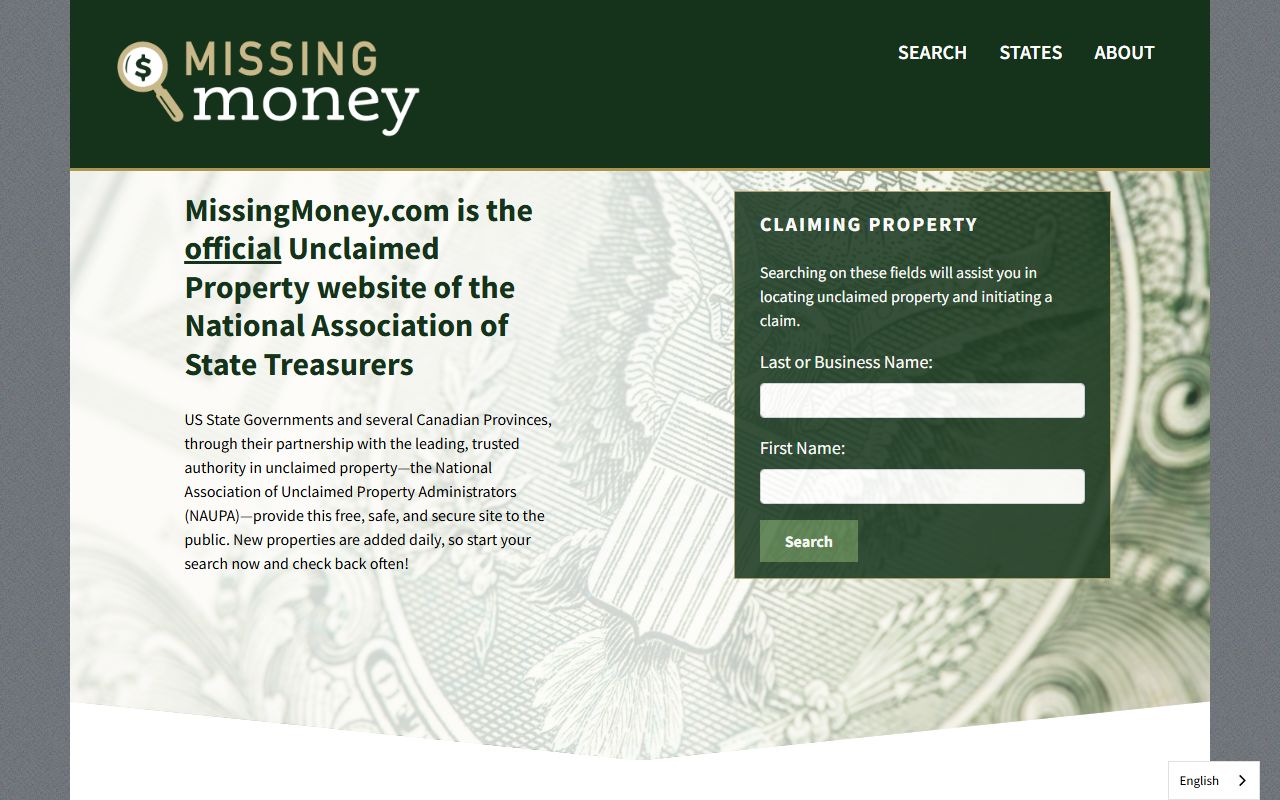
Use MissingMoney.com as a second check after the Utah state portal, especially if you have ever lived outside Utah or have family members in other states.
Note: MissingMoney.com does not include all states. Always check the Utah state portal directly for the most complete Utah records.
What Counts as Utah Unclaimed Property
Unclaimed property in Utah covers a broad range of financial assets and physical items. Bank accounts top the list. Savings accounts, checking accounts, and certificates of deposit that go untouched for three years are reported to the state. The same applies to money orders after seven years and traveler's checks after fifteen. Wages and utility deposits get turned over after just one year without contact. Safe deposit box contents, stocks, dividends, mutual fund shares, and life insurance proceeds all fall under the same rules if the owner cannot be reached.
The Utah Treasurer's official unclaimed property page describes the source of these funds well. Financial institutions, insurance companies, public agencies, and businesses are required by law to turn over property to the state after the dormancy period ends and due diligence efforts to reach the owner have failed. The state holds it in trust with no expiration date. You do not lose your right to claim the property just because years have passed.
Common sources include forgotten checking accounts, overpaid medical bills, uncashed payroll checks, paid-up life insurance policies, refunds from utilities, dividends from stocks you forgot you owned, and contents left in abandoned safe deposit boxes. The state also holds tangible property from safe deposit boxes, including watches, jewelry, coins, stamps, and historical items.
The Utah Treasurer's website explains how property moves from holder to state and what types of assets are covered under Utah's unclaimed property program.
Utah Unclaimed Property Dormancy Periods
Utah law sets specific dormancy periods for each type of property. Once a period ends with no owner contact, the holder must report and turn the property over to the state. The period starts from the last confirmed owner activity, which could be a deposit, withdrawal, correspondence, or other documented interaction. Most property types carry a three-year dormancy period.
The NAUPA Utah reporting page summarizes the main periods: checking and savings accounts go dormant after three years, as do dividends, securities, money market accounts, IRAs, accounts payable balances, credit balances, and customer refunds. Wages and utility deposits go dormant in one year. Money orders require seven years. Traveler's checks require fifteen. Gift certificates carry a five-year period under Utah statute. Property from business dissolution goes to the state one year after it becomes distributable.
- Wages and utility deposits: 1 year
- Property from court, government, or business dissolution: 1 year
- Checking and savings accounts: 3 years
- Life insurance proceeds, dividends, stocks, IRAs: 3 years
- Customer refunds and credit balances: 3 years
- Money orders: 7 years
- Traveler's checks: 15 years
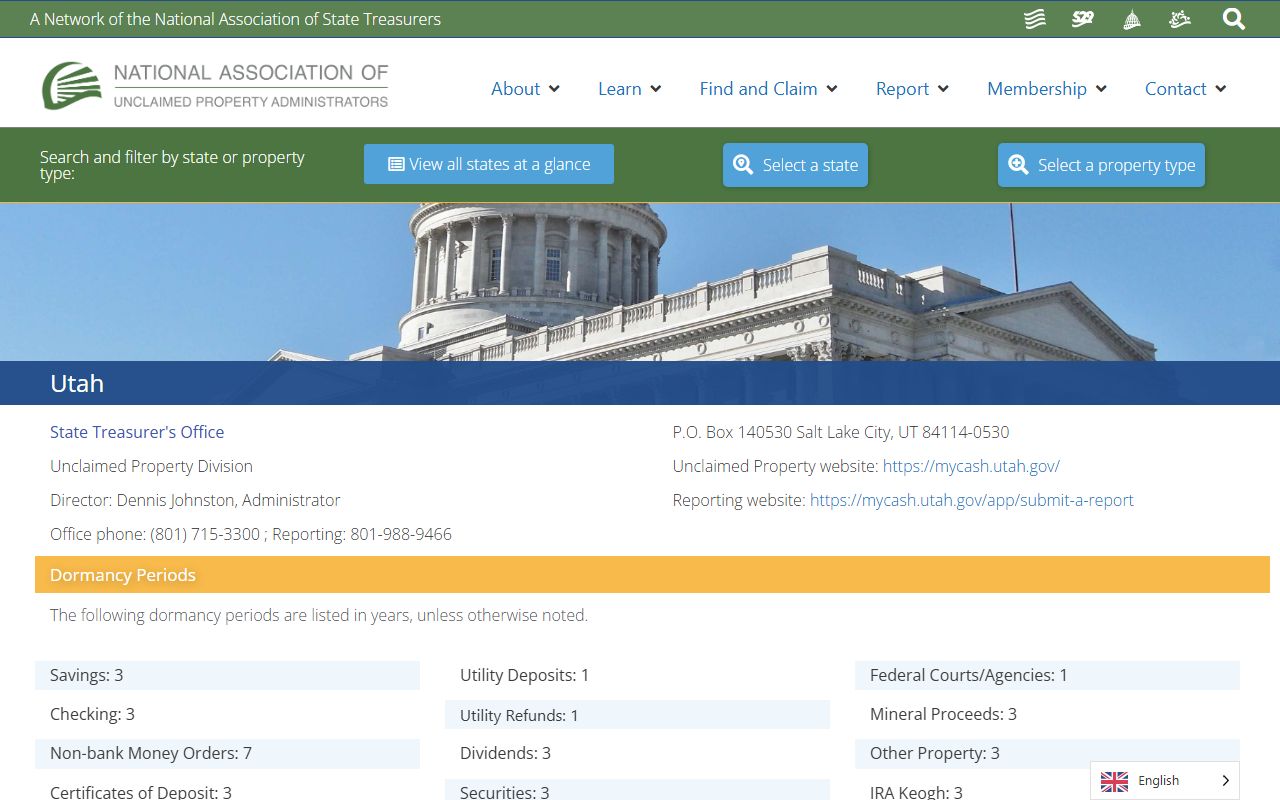
The NAUPA Utah page lists current deadlines and dormancy rules that apply to both holders reporting property and owners searching for their funds.
How to Claim Utah Unclaimed Money
Filing a claim starts at mycash.utah.gov. Search your name. If results appear, click to begin the claim process. You will fill out a form with your name, contact information, and current address. Next, you upload supporting documents to verify your identity and ownership. Required documents typically include a government-issued photo ID such as a driver's license and your Social Security card. Depending on the property type, you may also need bank statements, insurance policy documents, or other records linking you to the account.
Claims can be submitted online through the secure portal. You can also print a claim form and mail it with copies of your documents to: Unclaimed Property Division, P.O. Box 140530, 168 N 1950 W Suite 102, Salt Lake City, UT 84116. After you submit, you can check your claim status online. Review typically takes several weeks. Approved claims are paid by check or direct deposit. Utah law under Utah Code Title 67 Chapter 4a sets no deadline for claiming property, so the funds remain available no matter how long ago they were reported.
Heirs can also claim funds on behalf of a deceased owner. Additional paperwork is required in those cases, including a death certificate and probate documents if applicable. Contact the division directly at (801) 715-3300 if your situation involves an estate or trust.
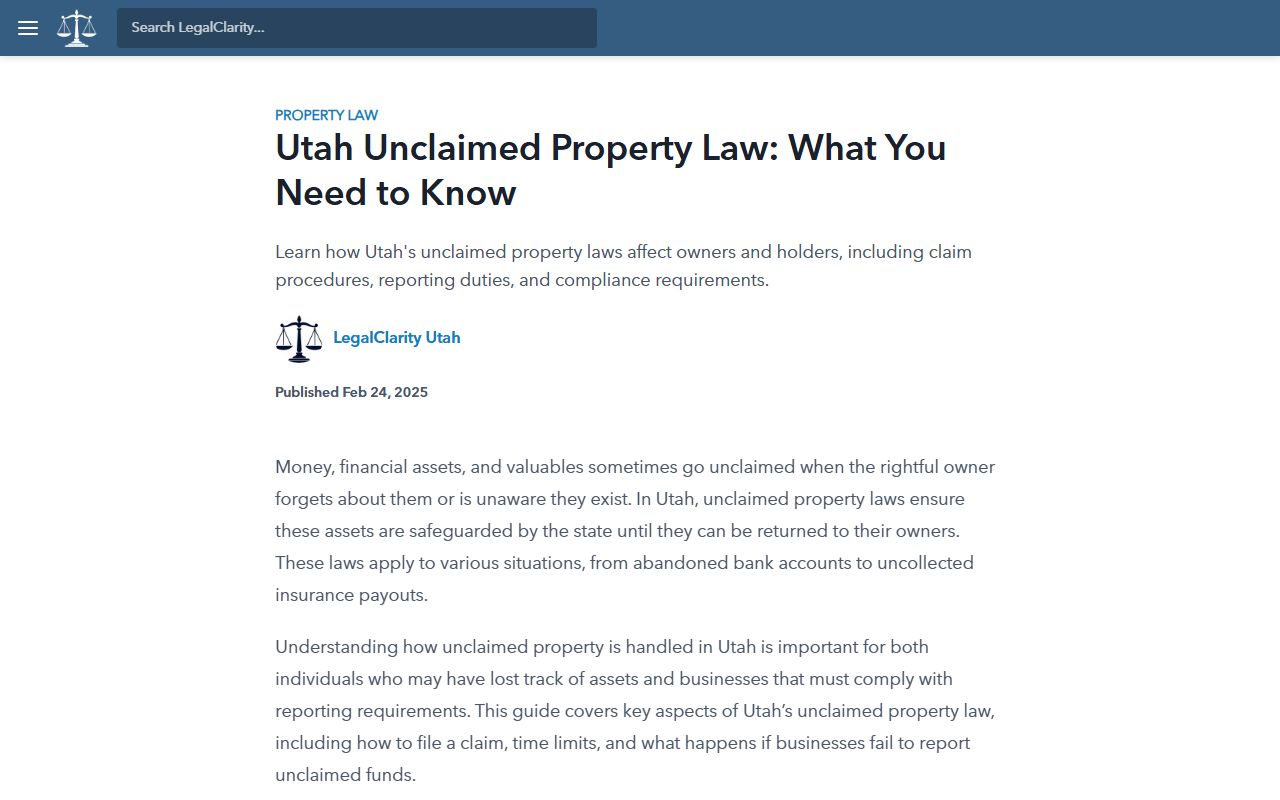
Resources like Legal Clarity's Utah unclaimed property guide walk through the documentation requirements and what to expect during the review period for different types of claims.
Utah Unclaimed Property Laws
Utah's unclaimed property program runs under the Revised Uniform Unclaimed Property Act (RUUPA), codified in Utah Code Title 67, Chapter 4a. The act was updated most recently in 2017 and 2018. It covers all aspects of how property is defined, how dormancy is measured, what holders must do before turning property over, and how claims are processed.
Section 67-4a-201 of the Utah Code sets the presumption of abandonment for each property type. Section 67-4a-501 confirms that Utah does not set a deadline for owners to reclaim their property. The state holds it in trust indefinitely. Section 67-4a-607 governs income or gain on property held by the administrator. If non-cash property generates income before it is sold, the owner is entitled to that income. However, interest does not accrue on cash held by the state. Section 67-4a-701 describes how property that cannot be claimed is eventually sold through public auction, with proceeds remaining available to the rightful owner.
Section 67-4a-903 requires the claimant to verify the accuracy of their claim. This is a straightforward step but an important one. False claims carry legal risk. The law is designed to protect both the owner and the integrity of the program.
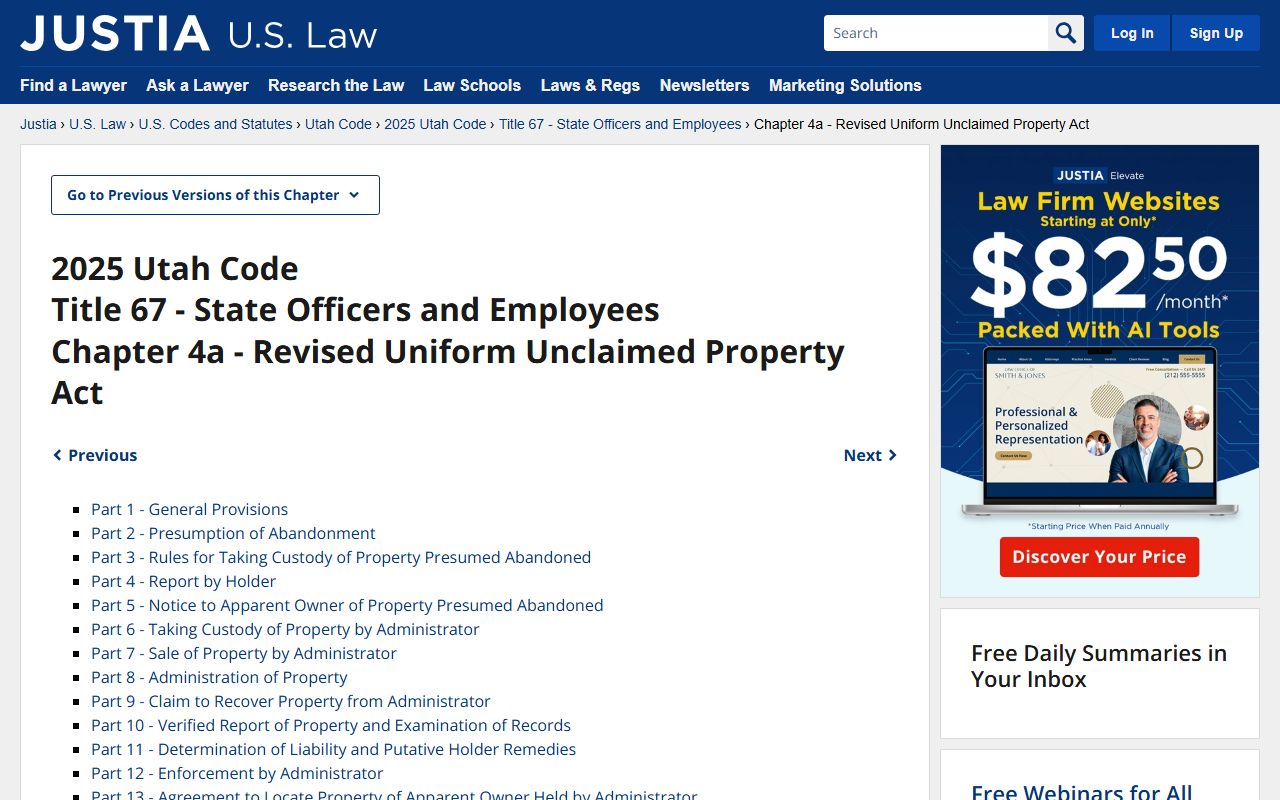
The full text of Utah Code Title 67, Chapter 4a is publicly available and covers every provision of the Revised Uniform Unclaimed Property Act as adopted and amended in Utah.
Reporting Requirements for Utah Businesses
Businesses, banks, insurance companies, utilities, and other holders of unclaimed property in Utah must report annually by November 1. The report covers property that became dormant during the prior fiscal year. Holders must submit reports electronically in NAUPA II format through the secure portal at mycash.utah.gov. Paper reports are no longer accepted. Utah does not require a negative report if a holder has no unclaimed property to disclose for the year.
Before the November 1 deadline, holders are required to perform due diligence. For any property worth $50 or more, the holder must send a written notice to the owner's last known address between 60 and 180 days before filing. The notice must explain the nature and value of the property, state that it will be turned over to the state, and tell the owner how to prevent the transfer. If the owner has agreed to electronic communication, the notice must go out by both mail and email. These rules are detailed in the Sovos Utah unclaimed property compliance guide and in Utah statute.
The Unclaimed Property Professionals Organization (UPPO) provides compliance resources and a Utah-specific reporting guide for businesses that need to meet their annual filing obligations.
Utah also offers a Voluntary Disclosure Agreement (VDA) program for holders who missed prior reporting deadlines. Eligible participants receive a waiver of penalties and interest, a defined lookback period, and a structured timeline for catching up on past-due reports. To qualify, the holder must not be under active audit and must be filing for the first time. More detail is available in the Eisen Utah escheatment compliance guide.
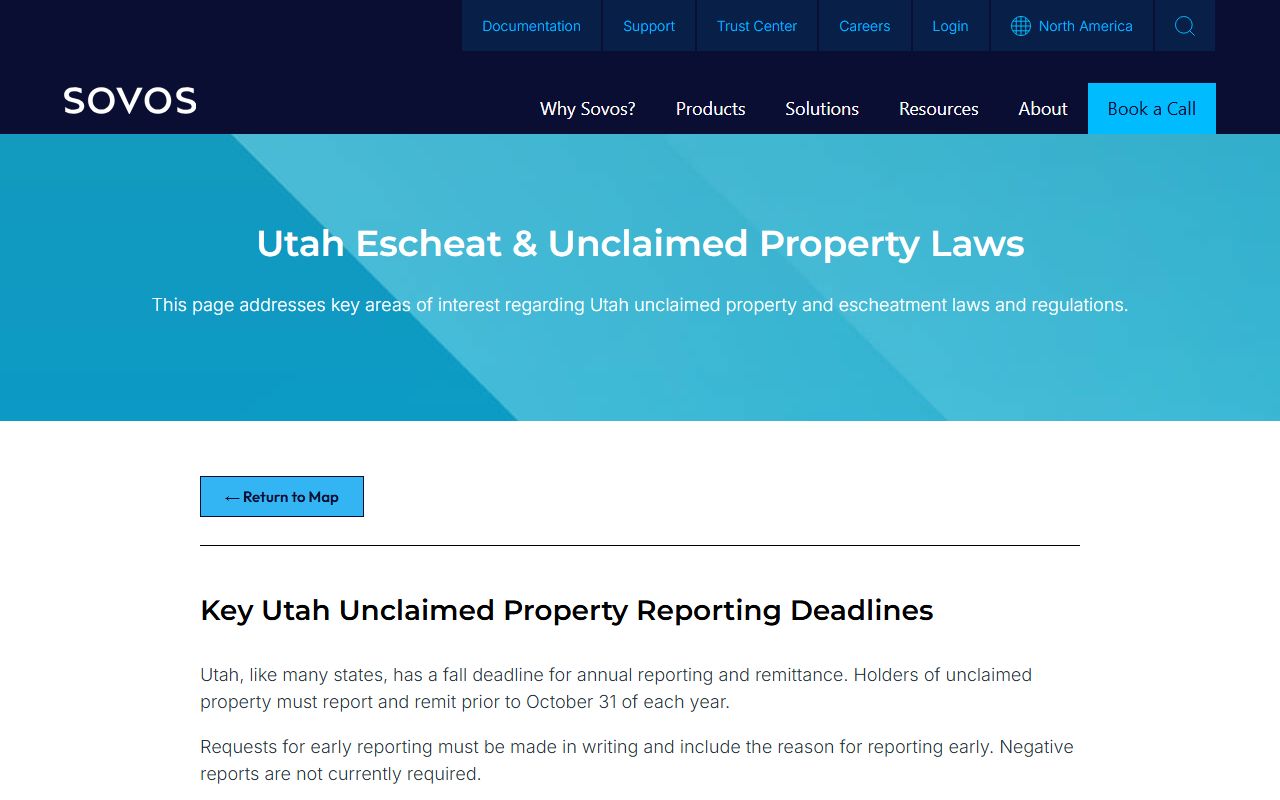
The Sovos compliance guide summarizes Utah's reporting deadlines, due diligence standards, and remittance requirements in a format geared toward business compliance teams.
Utah Escheatment Compliance and VDA Program
Utah's voluntary disclosure agreement program gives businesses a structured way to correct unreported unclaimed property without facing the full weight of audit penalties. The state prefers voluntary compliance over enforcement where possible. The Eisen Utah escheatment laws guide covers what property types are reportable, how the dormancy clock works, and what the VDA application process involves. Common reportable items include uncashed payroll checks, vendor checks, customer refunds, abandoned bank accounts, dividends, and safe deposit box contents.
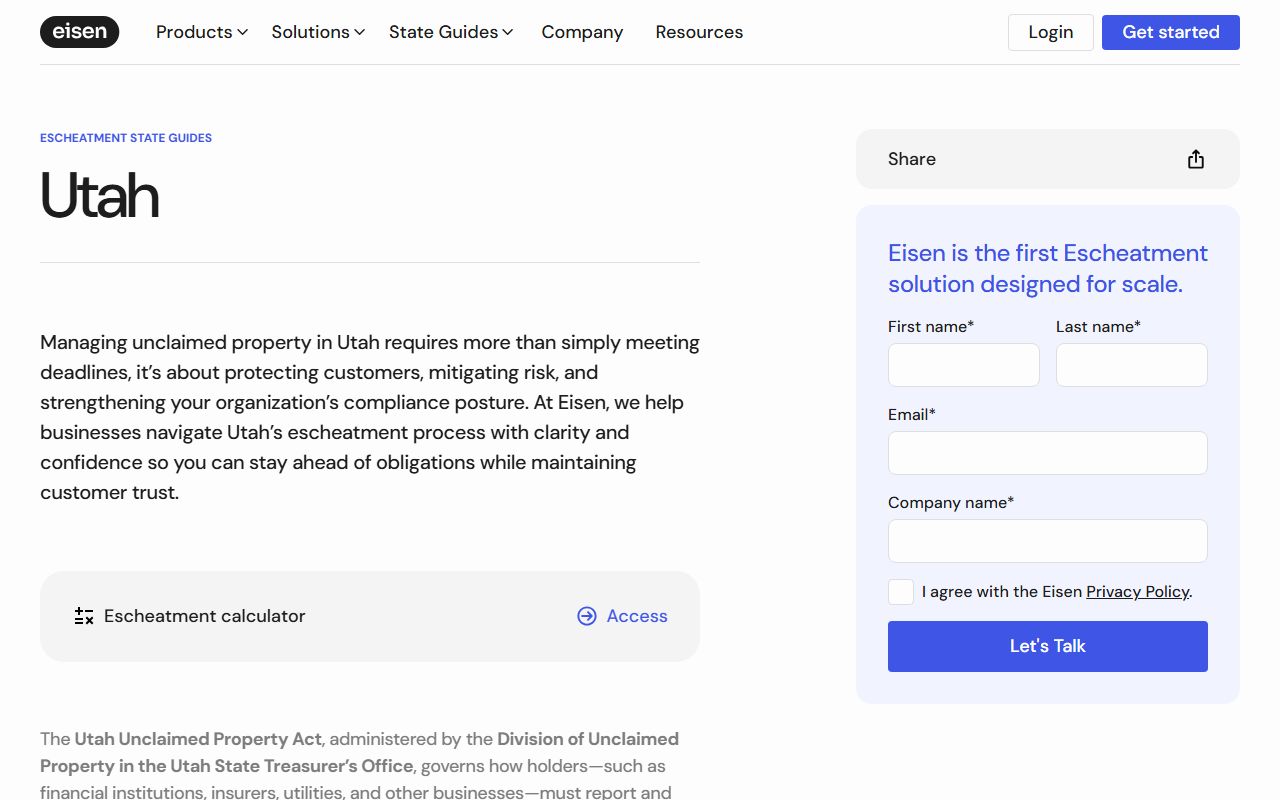
The Eisen guide walks through dormancy periods by property code and explains Utah's due diligence rules in detail, useful for any holder preparing an annual report.
Unclaimed Tax Refunds in Utah
The Utah State Tax Commission works alongside the Unclaimed Property Division on matters involving tax refunds. Unclaimed state tax refunds that remain uncollected are eventually turned over to the Treasurer's Office. Federal tax refunds follow a separate process through the IRS. According to IRS data, Utah residents had approximately $8.2 million in unclaimed 2020 federal tax refunds, with a median refund amount of $836. Taxpayers generally have three years from the original filing deadline to claim a federal refund before it goes to the U.S. Treasury.
If you think you may have an uncashed state refund check, search your name at mycash.utah.gov first. The Treasurer's office holds refunds turned over by the Tax Commission the same way it holds any other unclaimed property. You can also contact the Tax Commission directly through tax.utah.gov to check the status of a recent return.
The Utah State Tax Commission handles state income tax administration and coordinates with the Treasurer's Office on refund checks that have gone uncashed or undelivered.
Enforcement and Scam Protection
The Utah Attorney General's Office plays a role in enforcing unclaimed property laws and protecting consumers. The office has authority to pursue holders who fail to report and remit as required. In 2024, Utah received approximately $3.5 million from a U.S. Supreme Court ruling that redirected certain unclaimed funds back to the originating state rather than the state of incorporation. That settlement demonstrates how seriously the state takes its role as custodian of unclaimed money.
Scams tied to unclaimed property are common. Watch out for postcards, emails, or calls claiming they can find and recover your unclaimed money for a fee. The Utah Attorney General warns that the state never charges a fee to return property. Anyone offering to recover your unclaimed money for a percentage is not necessary. You can search and claim on your own for free at mycash.utah.gov. If you receive a suspicious contact, report it to the Attorney General's consumer protection unit.
The Utah Attorney General's Office investigates fraud related to unclaimed property and works with the State Treasurer to ensure holders comply with reporting obligations.
Business Entities and Unclaimed Money
The Utah Division of Corporations and Commercial Code maintains Utah's business registry. This database is useful when searching for unclaimed funds tied to a business. If you need to verify a company's registration status before reporting property or filing a claim, the Division of Corporations is the right starting point. You can search by entity name, number, or officer name. Businesses that were dissolved or merged may have left unclaimed funds behind, and those are reportable under state law.
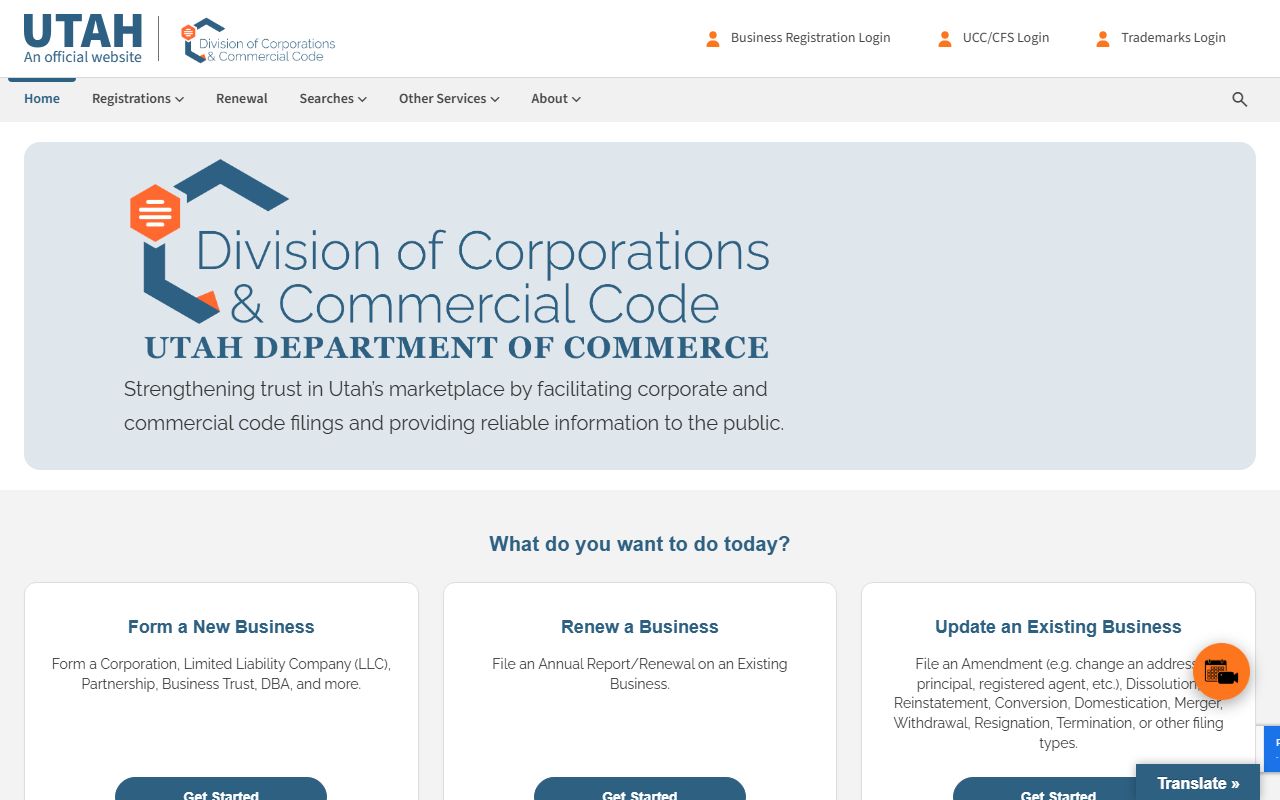
The Utah Division of Corporations provides a public business registry search that helps holders and claimants verify entity status when dealing with corporate unclaimed property.
A Record of Returning Utah Unclaimed Money
Utah's unclaimed property program has operated since 1957. Since 1984, the division has returned roughly $131 million to rightful owners and their heirs. The 2022 fiscal year was a record-setter. The division received $77.2 million in newly reported property and returned $30.6 million to owners during that same period. It processed 496,880 new cash and tangible property items by the November 1 deadline, the highest volume in the program's history. The state also sent out 796,388 direct mail postcards to residents in economically depressed communities to help them find funds they may not know about.
The division partnered with the Utah Automated Geographic Reference Center to build a tool that maps unclaimed property data by census tract, county, senate district, and house district. That tool lets the division target outreach where the need is greatest. Tangible items from safe deposit boxes in the state's custody include watches, jewelry, coins, currency, stamps, and historical items dating back many decades.
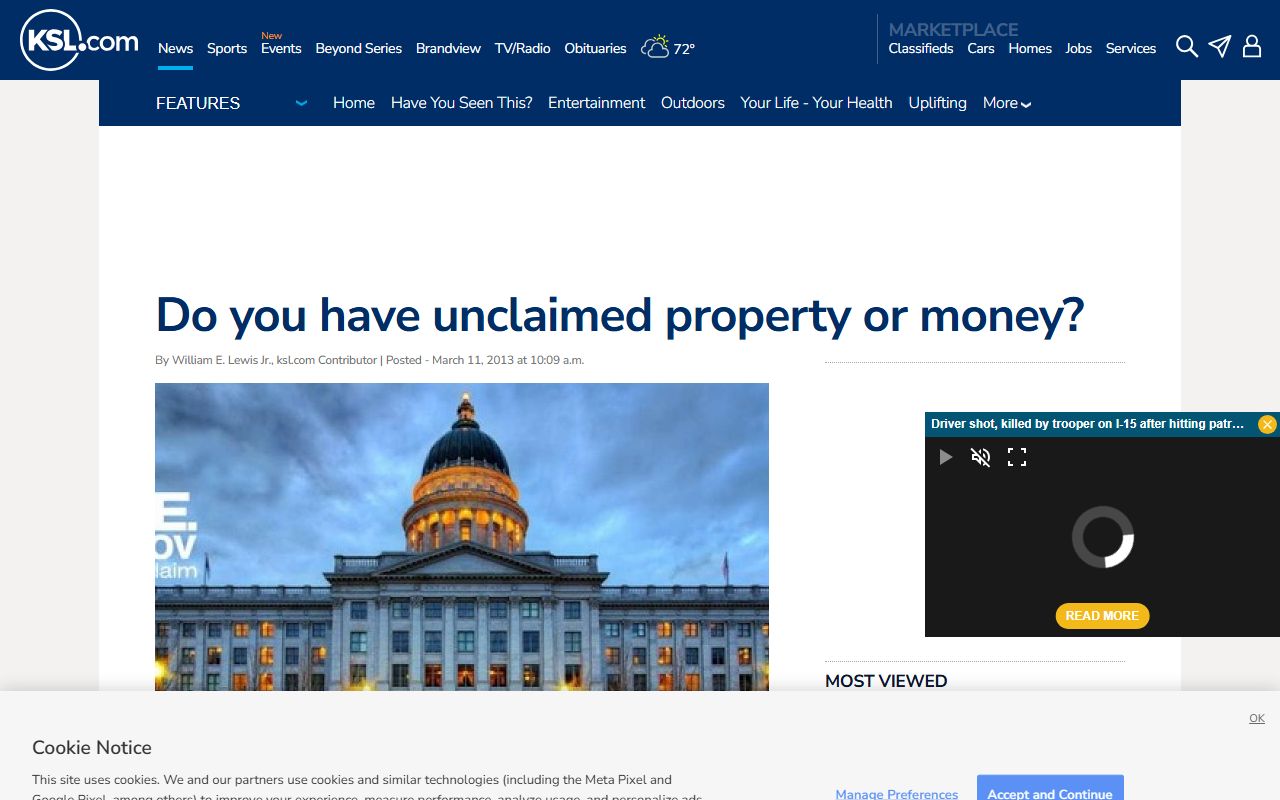
KSL News has covered the Utah unclaimed property program in depth, highlighting the range of items held by the state and the division's efforts to return money to residents across every county.
Step-by-step guides for claiming Utah unclaimed money are available through resources like UPPO and the official state portal, covering documentation, submission, and tracking.
Find Utah Unclaimed Money by County
Unclaimed money in Utah is held at the state level, but county offices can help with property tax refunds and local records. Select a county to find local resources and contact information for unclaimed money in that area.
Utah Unclaimed Money by City
Residents of major Utah cities can search the state database using their name and current or former address. Select a city below for local resources, county courthouse information, and unclaimed money search help.